

No one is born knowing how to pilot a high-performance powerboat. Though some learn faster than others, the skills needed are anything but innate. That’s why Tres Martin, an offshore racing champion since retired from the sport, founded the Tres Martin Performance Boat School in 2003. Since then, hundreds of drivers has graduated from the program he built with fellow instructor Brad Schoenwald, whose specialties during his long career in the United States Coast Guard included “human performance technologies” and “Instructional Technologies.”
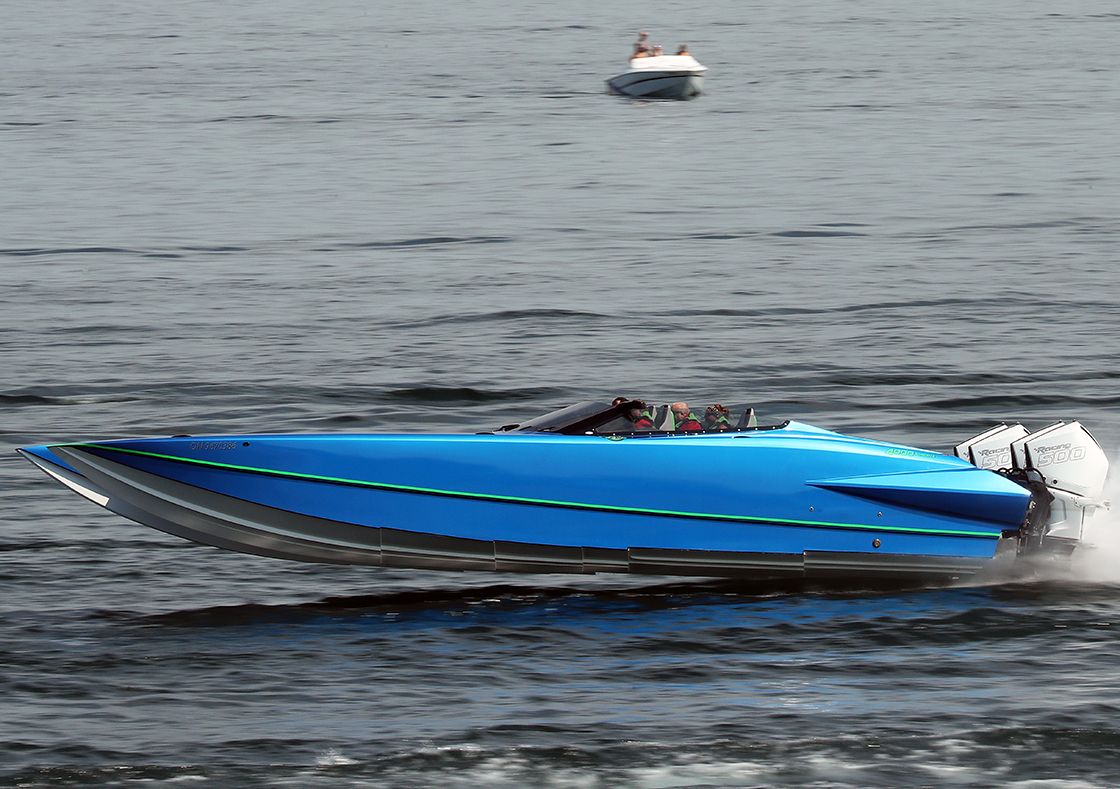
Though its roots are in the high-performance powerboating world, the Tres Martin Boat School has expanded significantly during the past 23 years. Photo by Jeff Helmkamp copyright Helmkamp Photos.
“In an industry often defined by horsepower, speed, advanced technology, and increasingly sophisticated hull designs, the Tres Martin Performance Boat School has spent more than two decades emphasizing something equally important—the person behind the wheel,” Schoenwald explained. “What began as a specialized training program for high-performance powerboat enthusiasts has since evolved into a broader maritime instructional organization, offering courses for recreational boat operators, high-performance catamarans and V-bottoms, stepped-hull center consoles, sport yachts, and government vessel operations.
“Along the way, the school has developed a longstanding reputation for individualized instruction, practical competency-based training and the belief that operating experience alone does not necessarily establish operator proficiency,” he added.
Schoenwald also currently works as a senior marine inspector and lead instructor at the Coast Guard’s Cruise Ship National Center of Expertise, “contributing to advanced technical training and performance-based curriculum development in addition to the actual vessel inspections on the most technologically advanced ships in the world,” he said.
The combination of Martin’s exceptional knowledge of vessel design and high-performance handling with Schoenwald’s professional background in systematic instructional development helped establish a distinctive training philosophy. Rather than merely demonstrating how a boat should be driven, the school developed structured training curricula identifying specific operator competencies, learning objectives, and practical performance standards.
That philosophy remains central to the school’s instructional identity.
The instructional team has continued to draw upon specialized backgrounds. Instructor Jose Delgado, who brings more than two decades of maritime operational training experience, including Naval Special Warfare, high-speed assault craft operations, specialized boat handling, and tactical maritime instruction, is part of the team. And the Tres Martin Boat School has grown with it.
Current course offerings include foundational performance boat instruction, dedicated center-console programs, advanced and ultimate high-performance training, sport yacht operation, yacht delivery and customized government training.
Modern stepped-hull center consoles can achieve speeds once associated almost exclusively with offshore performance boats. Larger recreational yachts incorporate increasingly complex propulsion, navigation, and control systems. High-performance catamarans and V-bottoms continue to push technological and operational boundaries.
Each vessel category presents different challenges, requiring more than a one-size-fits-all training approach. The school has responded with curricula tailored to vessel design, propulsion configuration, handling characteristics, intended operation, and the experience of individual students. Coursework includes hull dynamics, trim and tab management, acceleration and deceleration, turning techniques, emergency recovery, situational awareness, docking and vessel-specific operating procedures.
Far from pay-and-pass, all course emphasize measurable terminal performance objectives. Rather than relying exclusively upon classroom attendance or accumulated operating hours, advanced courses require students to demonstrate specific competencies.
The insurance industry also has recognized the importance of improved operator competency. Marine insurer Markel publicly identifies itself as a supporter of Tres Martin Performance Boat School. Successful completion of certain courses is recognized or required by some insurers, depending upon the vessel and policy.
Whether the student is a first-time performance boat owner, an experienced high performance catamaran operator, a recreational yacht owner, or a professional military boat operator, the underlying educational principle remains the same: effective training must produce demonstrable improvements in operational performance.
While horsepower, speed, and vessel technology will continue to evolve, the fundamental need for knowledgeable, competent, and responsible operators remains unchanged: A boat’s capabilities may be determined by its design and engineering—but its safe operation ultimately depends upon the knowledge, judgment and demonstrated skills of the person at the helm.