

From the number of teams in any given fleet to the relative parity among them, no class in offshore powerboat racing is more competitive than Super Stock. Just ask Jeremy Tschida, the second-year owner/driver of the Tschida Family Racing/Wozencraft team. Tschida, who lives in Minnesota but has a second home in Southwest Florida spent his rookie season taking one hard knock after another—most of the mechanical kind—alongside veteran throttleman and Manatee Marine Unlimited co-owner Julian Maldonado in their 31-foot catamaran.
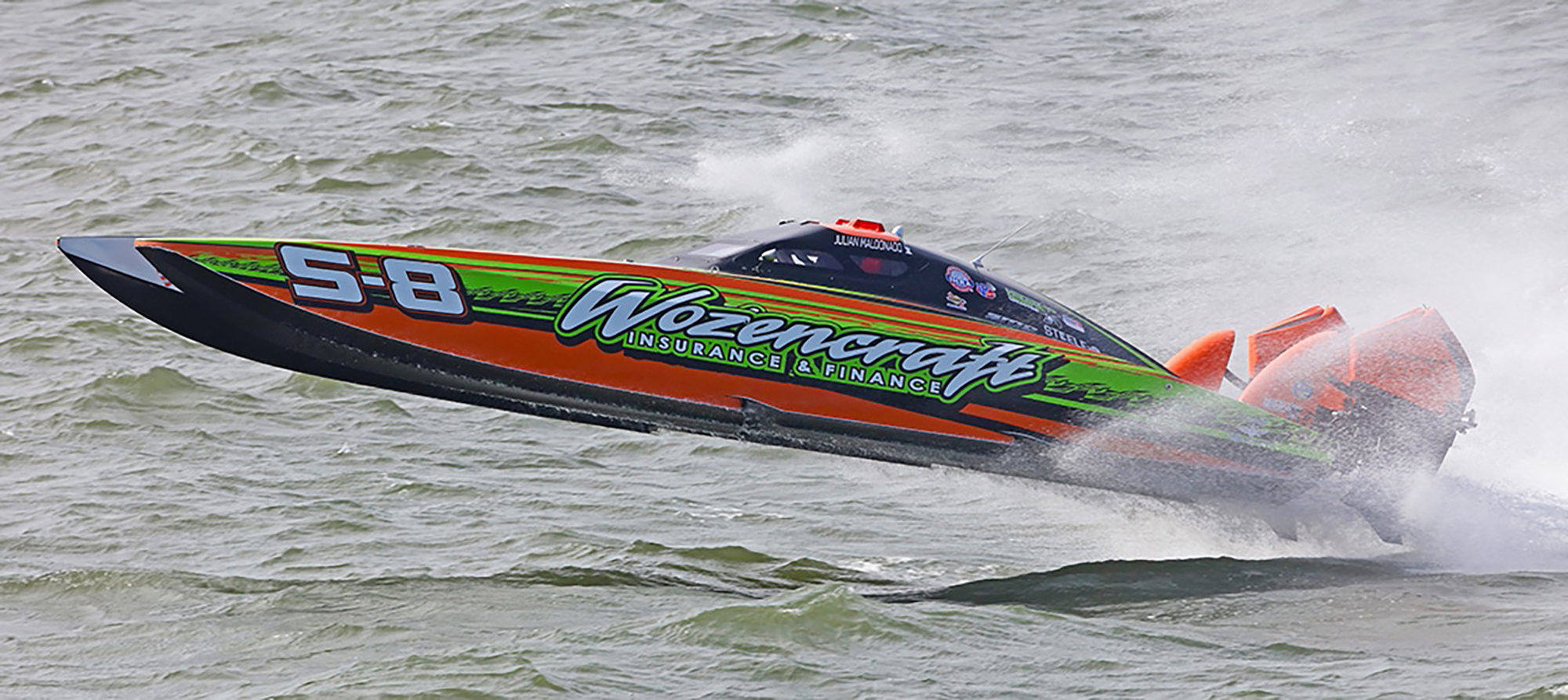
The Super Stock-class TFR/Wozencraft team notched its first win during the New Orleans Grand Prix and currently sits seconds in the IHRA Offshore Series point standings. Photo by Pete Boden copyright Shoot 2 Thrill Pix.
Now with the inaugural International Hot Rod Association St. Petersburg and New Orleans events behind them, Tschida and Maldonado are just eight points out of first place behind Team Bermuda/GL Construction in the inaugural IHRA Offshore Series. They finished third in the Southwest Florida season-opener and claimed their first Super Stock-class checkered flag in the Louisiana affair.
Super Stock-class victories are nothing new to Maldonado—he notched a slew of them alongside Jackhammer team owner/driver Reese Langheim during their time competition in the category. But the New Orleans win was a first for his Super Stock-class racing partner.
“I can’t tell you how excited I was,” Tschida said, then chuckled. “My emotions were over the top—I was hooting and hollering and yelling. I knew we would get there eventually, but when it finally does you’re like, ‘Did that really just happen?’ Julian and I were ecstatic and my wife, Kristie and son ,Tyler were ecstatic.
“We knew Team Bermuda would be fast based on their wining performance in St. Pete, but I felt like we were pretty dominant in New Orleans,” he continued. “We did a lot of testing to get our setup right and I thought we had it pretty good. But as soon as Julian hit the throttles and I looked left and looked right no one was there, I was like, ‘Whoa, this is pretty bad ass.'”
Like all the teams, TFR/Wozencraft had the option of running two short laps in the 11-1/2-lap New Orleans contest. All teams had to run the long circuit on the first lap, but per their pre-race plan Tschida and Maldonado attacked the short course on their second and third laps.
“We decided that if we got out front we would take the short laps as early as possible,” Tschida explained. “Julian’s theory was to get out front and put gap between us and the rest of the teams.”
Near the end of the race, cockpit duo lost radio communication with its spotters on shore. They also lost track of their laps completed.
“I was pretty sure we were on the white-flag lap but we didn’t see the white flag come,” Tschida admitted. “So when we came around the last turn I asked Julian if the white flag was out then. He said, ‘No, but I have better news for you. There’s the checkered. We just won.’
“It was pretty emotional,” he added. “And it was a big relief. We finally got it put together.”
The IHRA Offshore Series continues next month in Cocoa Beach, Fla., and Tschida and Maldonado are eager to attack what they hope will be a rough-water course. A veteran offshore competitor, Maldonado has long said he prefers rough conditions to flat water, and the open Atlantic Ocean waters off the Central Florida Coast venue are notorious for delivering them.
“We will do well in that water,” Tschida said. “Even though we have a smaller boat that a lot of teams, Julian is the equalizer. I don’t like to say this, but smooth-water races are more of a setup game. Rough-water racers take more teamwork between driver and throttleman, and we’re feeling pretty good about that.”